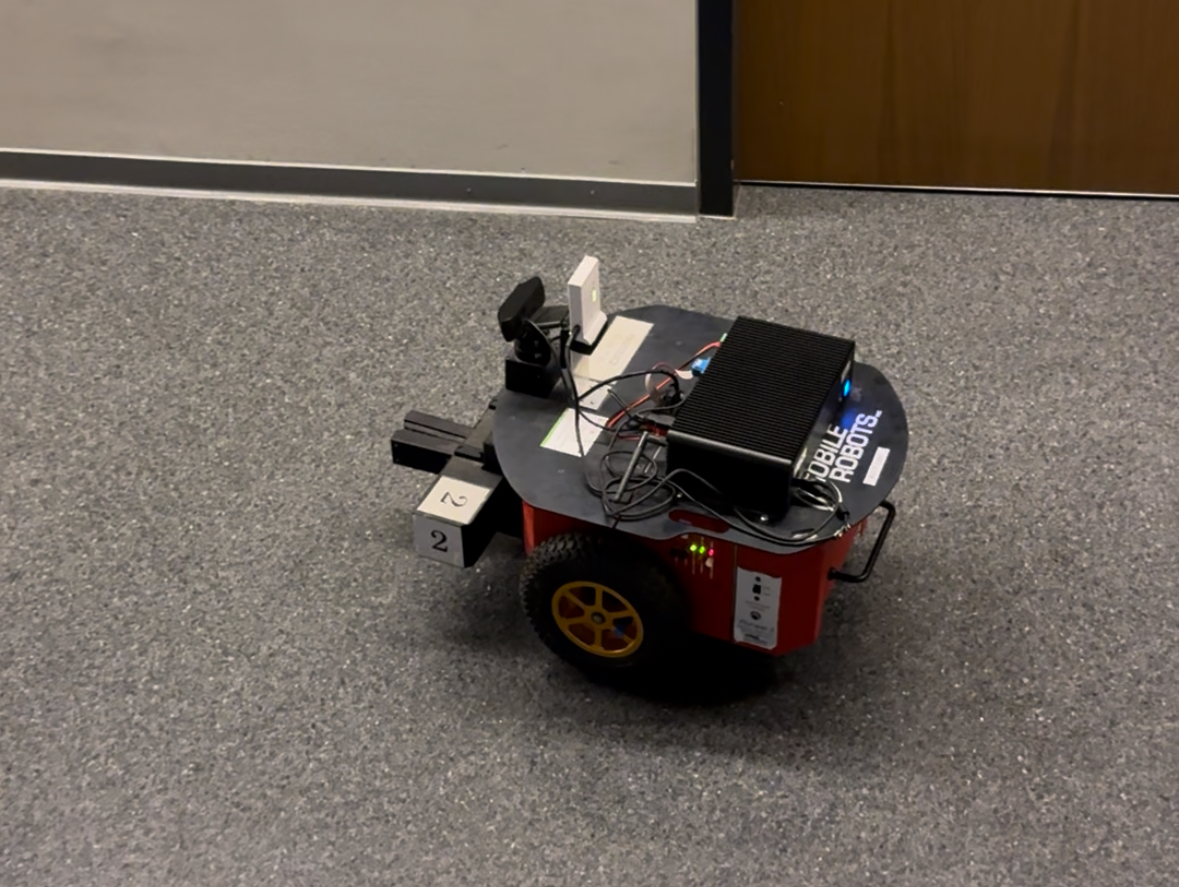
Pioneer mobile robot
Description
The project involved the development of a navigation stack for a mobile robot, specifically the Pioneer mobile robot. The navigation stack was designed to enable the robot to navigate to a given goal while avoiding obstacles in its path. The project was implemented using the Robot Operating System 2 (ROS2), which is a popular framework for developing robotic applications.
The navigation stack was built from the ground up, utilizing various ROS2 packages and libraries. The stack includes components for mapping, localization, path planning, and obstacle avoidance. The mapping component uses the SLAM (Simultaneous Localization and Mapping) algorithm to create a map of the environment while simultaneously localizing the robot within that map. Path planning is achieved using the Wavefront algorithm, which calculates the optimal path from the robot’s current position to the goal while avoiding obstacles. The obstacle avoidance component uses sensor data from the robot’s cameras and LIDAR to detect obstacles in the environment and adjust the robot’s path accordingly.
Source code for this project is available on my Gitlab repository.
This project was made for my university course called “Mobile Robotics” at Wroclaw University of Science and Technology.